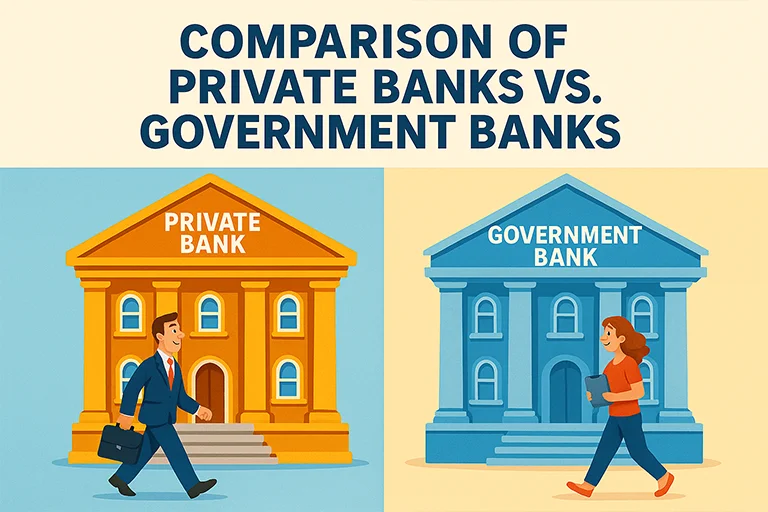
In India, the decision between Private Sector Banks and Government Banks can be very confusing but also very important. Both banks perform vital functions in India’s financial system but differ in ownership, customer experience, technology, and service culture.
Understanding such differences would help you with your financial choices if you are someone who would value digital innovation over high service charges or vice versa.
Private Banks
What's inside?
A private sector bank is one that is run and owned by individuals and/or private companies, including firms. Notably, HDFC Bank, ICICI Bank, Axis Bank, Kotak Mahindra Bank, and IndusInd Bank are considered some of the best private banks in India.
They are generally known for providing modern banking solutions, advanced digital platforms for transaction management, and customer care services tailored to meet requirements for lifestyle opportunities of working professionals and entrepreneurs, who are predominantly the tech-savvy population.
Advantages of Private Banks
1. Better Customer Service : The customer experience is greatly emphasized by private sector banks. You can expect:
- Reduced waiting times at branches
- 24/7 customer support (phone, chat, or app)
- Relationship manager assigned to very important customers
- Individual advice on credit cards and investment.
2. Interesting Financial Products: Private banks are famous for working out new products, marketing campaigns, and service offers for:
- Fully-loaded credit cards with benefits like cashback and reward points
- Instant personal loans with speedy approvals
- Fixed deposits that can be customized with flexible tenures
- Digital wealth management tools for goal-oriented investing.
3. Improved Digital Banking Experience: These banks are leading the digitalization wave in India. On their mobile app and website, a customer can:
- Transfer funds via NEFT, RTGS, IMPS, and UPI
- Auto-pay their bills and EMIs
- Deposit cheques through mobile scanning
- Get real-time customer support on apps
Considerations for Private Banks
While providing an exceedingly smooth experience, they charge a hefty fee for:
- Higher minimum balance requirement
- Service fees for ATMs or for other uses of card
- Loan processing fees & maintenance
If you book prices for convenience, you will face some costs that may be a drawback in your case.
What Are Government Banks?
Government banks (Public Sector Banks) are the banks that are more than 50% owned by the Government of India. Some examples are the State Bank of India (SBI), Punjab National Bank (PNB), Bank of Baroda, and Canara Bank.
These banks essentially deal with financial inclusion, with affordable services and trust-based relationships, with prime focus on rural and semi-urban clientele and middle-income patrons.
Advantages of Government Banks
1. Low or Nil Service Charges: These public sector banks are considered cost-based ones. They charge low service charges for-
- Savings account maintenance
- ATM withdrawals
- Loan applications (when they accept the eligible borrower)
The target clientele are students, pensioners, and low-income customers who want basic banking and services without high fees.
2. Huge Network of Branches and ATMs: SBI alone has more than 22,000 branches spread all over India. This makes government banks perfect for customers who favor in-person banking or those who are from rural sectors where private banks are not so prevalent.
3. High Trust and Security: With a complete backing of the Government of India, these banks inspire confidence; this is particularly true for a generation and conservative investors. Buildings feel safe even in the most uncertain times.
Considerations for Government Banks
Even though these banks are reliable, they are made to suffer by:
- Slow digital innovation
- Long queues and delayed services in branches
- Less personalized consumer experience
However, they are catching up fast; many banks are actively providing UPI app, online loan portals, and mobile app improvements.
Private Banks vs Government Banks: A Quick Comparison
| Features | Private Banks | Government Banks |
|---|---|---|
| Customer Service | Highly personalized & responsive | Slower, less customized |
| Digital Experience | Advanced & user-friendly | Improving but basic |
| Fees & Charges | Higher | Lower |
| Branch Access | Limited in rural areas | Extensive nationwide presence |
| Product Innovation High Medium | High | Medium |
| Trust & Security | Market-driven | Government-backed |
| Target Users | Professionals, urban customers | Students, pensioners, rural customers |
Which Bank Should You Choose?
The bank that suits you best largely depends on what you value most.
Choose a Private Bank if you need:
- Quick digital services and immediate support
- Innovative products and app-considered conveniences
- Modern vibes and comfort with a little more expense
Choose a Government Bank if you want:
- Complicated yet cheap banking
- Easy access in sight through branches
- Unquestionably trusted and safest in the Constitution of this country
Expert Tip:
- With an ever-expanding interest in development and technological evolution, a common and preferred banking mix by many Indians today is one that uses both the Private and the Public Models.
- A private bank determines ease and quick day transactions,
- A government bank captures strategic long-term savings and fixed deposits.
This way, you receive not only safety but the best of both worlds: innovation + security.
FAQs
1. Which bank is more secure- private or public?
Both are regulated by RBI, and the second enjoys higher safety due to government ownership.
2. Do private banks offer better returns on deposits?
Not always. At the maximum, private banks offer a little better interest on FDs, but the rates are almost equivalent in both sectors.
3. Which is better for loans- public or private banks?
Private ones offer faster processing and flexible options, while government banks usually provide lower interest rates and fewer hidden charges.

Digital marketing professional with over 10 years of experience across multiple areas including WordPress website management, email marketing, SMS marketing, Mail server administration (Linux), Google Ads, and basic programmatic advertising (DSP). With hands-on experience in content management, affiliate marketing contributes to delivering optimized digital solutions and smooth website operations.